
The short answer is to compare a full year, not one monthly plan
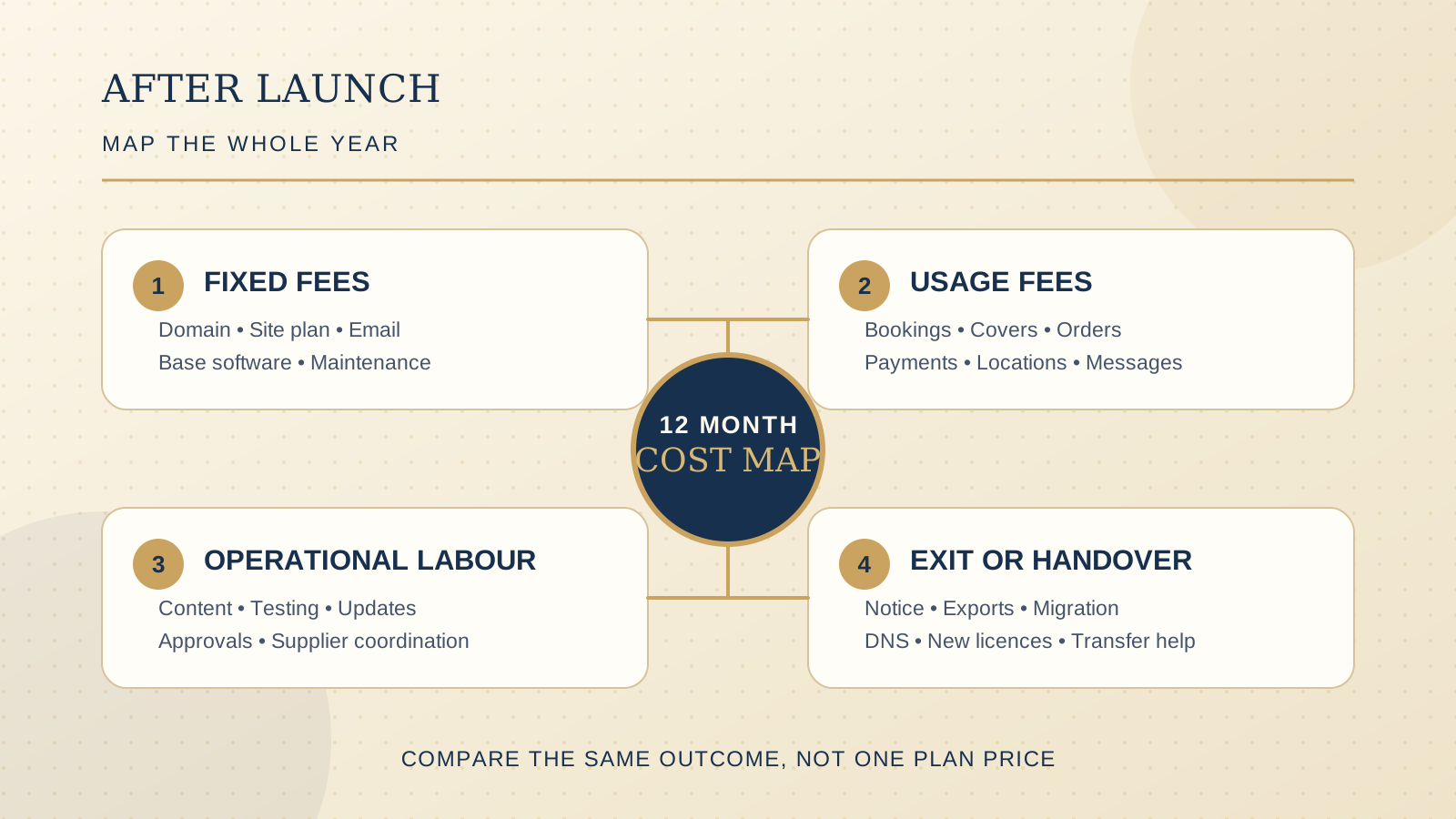
Ask every supplier for a 12 month cost map based on the way your venue actually operates. It should show fixed renewals, charges that rise with bookings or orders, the human work needed to keep information current, and the likely cost of leaving or handing the site over.
A low website plan can still sit beside a separate domain renewal, several email accounts, a reservation subscription, per-cover charges, payment processing, and paid updates. A higher monthly service may include several of those jobs. Neither model is automatically better. The useful comparison is the same scope, same usage assumptions, and same period.
Plan names, prices, inclusions, taxes, and contract terms can change by region and billing period. Use the current proposal and official pricing page when you make the decision. Record the date, currency, tax treatment, billing term, and renewal conditions instead of copying a price into a permanent budget.
Start with the fixed recurring costs
Fixed costs are the amounts you expect even in a quiet month. Some are billed monthly, some annually, and some only look free because they are bundled into another contract. Turn every item into an annual figure so a monthly plan and an annual renewal can be compared fairly.
- Domain renewal: The web address normally renews separately from the website plan. Confirm the registrar, owner, renewal date, billing contact, and whether privacy or other extras are separate.
- Website or hosting plan: This may cover hosting, an editor, security features, support, storage, and bandwidth. Confirm which features require a higher plan and what happens at renewal.
- Business email: Email is usually a separate service even when the website and domain appear under one brand. Count every paid mailbox and allow for new staff accounts.
- Booking, ordering, or property software: Record the base subscription for each location, booking book, ordering channel, room inventory, or connected module.
- Maintenance or care: Note what the recurring service includes, how much update time is available, how requests are submitted, and what becomes a separate quote.
- Other connected services: Forms, newsletters, accessibility tools, premium extensions, consent tools, stock images, fonts, analytics, or monitoring may renew independently.
Wix explains that a domain and a Premium plan are separate purchases, even when an eligible plan includes a temporary domain voucher. Squarespace also presents website plans separately from domains and connected services. The durable lesson is to list the account and renewal for each service, not assume one website payment covers everything.
The domain and hosting ownership guide shows how to keep those accounts under the venue's control while a trusted partner manages the technical work.
Add costs that move with bookings, orders, and payments
Usage-linked charges are easy to miss because they cannot be represented by one monthly number. They may depend on covers, orders, payment volume, message volume, rooms, locations, or optional services. They can be reasonable for the value delivered, but they need their own line in the cost map.
For each booking or ordering system, ask which of these can apply:
- A charge for each diner, booking, order, or transaction.
- Payment processing, including whether online deposits, no-show charges, gift cards, and refunds are treated differently.
- Commission or a service charge linked to a particular discovery network, marketplace, delivery method, or order source.
- Messaging, email, loyalty, delivery, or marketing charges that begin after an included allowance.
- Extra charges for another location, terminal, booking book, user, domain, menu, or integration.
OpenTable's plan page shows that restaurant costs can combine a monthly plan with cover charges that depend on how the guest books. Toast positions its own online ordering around a recurring software relationship rather than third-party marketplace commission, while its support material explains that plan availability and setup depend on the restaurant's Toast configuration. These are different cost models, not a simple cheap or expensive ranking.
Request a worked example using three months: a quiet month, a typical month, and your busiest month. Use your own expected covers, direct orders, average order value, locations, and payment mix. If a supplier cannot give a final amount in advance, ask for the formula and every assumption used.
Count the operational labour that keeps the site useful
A website does not stay current by itself. Hours change, menus are replaced, event pages expire, photographs age, booking links move, and staff leave. Even when the software fee is fixed, someone is spending time on those changes.
Write down who handles each recurring job and how long it normally takes:
- Changing hours, holiday notices, menus, prices, rooms, packages, and event details.
- Replacing images and keeping image rights, captions, and alternative text organised.
- Testing booking, ordering, enquiry, gift card, directions, phone, and email paths on a real phone.
- Checking form delivery, backups, broken links, software updates, account access, and basic search health.
- Coordinating approvals when the venue team, web partner, and platform provider each own a different part of the change.
Give internal time an agreed planning rate, even if no invoice is raised. Three hours of a manager's time is still a cost to the venue. On the other side, do not count a maintenance payment twice if the service already includes the same work. The restaurant website maintenance checklist can help define the repeatable jobs before you compare support options.
Allow for integration changes during the year
A booking widget, ordering button, room engine, map, form, menu feed, analytics tag, or payment link can change without the main website being redesigned. A provider may introduce a new connection method. The venue may switch systems, open another location, change its domain, or add a new service.
Ask whether the recurring agreement includes small connection repairs and tests. Then identify changes that would be quoted separately, such as replacing a booking platform, rebuilding an ordering flow, remapping many menus, adding a property system, moving several locations, or changing consent and measurement setup.
Set aside a sensible contingency line rather than pretending the year will contain no change. The amount should reflect the actual complexity of the venue. A cafe with one menu link has a different risk from a boutique stay with room inventory, payments, languages, and several third-party connections.
Price the exit and handover risk before you enter
Exit cost is not only a cancellation fee. It is the time and work required to keep the domain, copy, images, data, email, booking links, and search visibility usable when the current arrangement ends.
Before launch, confirm in writing:
- Who owns the domain, website account, design files, copy, photography, analytics, and connected service accounts.
- What content and data can be exported, in which format, and whether the exported material can be used without the current platform.
- What happens to the live site, forms, redirects, bookings, orders, and email if a subscription or maintenance agreement ends.
- How much notice is required, whether the contract renews automatically, and whether there are minimum terms or early termination conditions.
- What handover help is included, what is billable, and how domain, DNS, administrator, deployment, and recovery access will be transferred.
A platform can be the right operational choice even when moving away later requires work. The point is to understand that dependency and protect the assets the venue can keep. Keep original copy and images outside the site, keep an up-to-date account map, and test that the owner has access before a handover becomes urgent.
Build one 12 month cost map
| Cost bucket | Put these items here | Evidence to request |
|---|---|---|
| Fixed recurring fees | Domain, site or hosting plan, email, base software subscriptions, maintenance | Current proposal, billing term, renewal date, tax, inclusions, account owner |
| Usage-linked fees | Covers, bookings, orders, payment processing, commission, delivery, messages, added locations | Formula plus quiet, typical, and busy month examples |
| Operational labour | Content updates, guest path testing, technical checks, approvals, supplier coordination | Named owner, expected hours, internal rate, included support time |
| Exit or handover risk | Notice, termination, exports, migration, DNS changes, new licences, handover assistance | Contract terms, export sample, ownership list, transfer steps, estimated help |
For each line, record the supplier, billing owner, currency, tax, billing frequency, renewal month, included allowance, usage formula, responsible person, cancellation rule, and source date. Convert the expected total to one currency only after keeping the original quote and exchange-rate assumption.
Your planning total is: fixed annual fees, plus expected usage fees, plus internal and external labour, plus a realistic integration contingency. Keep exit exposure beside that total as a separate decision factor, because it may never be paid, but it still affects flexibility.
Compare the same outcome, not two plan labels
Option A may be a website plan that the owner updates. Option B may be a managed service with hosting and small changes included. To compare them fairly, both columns must reach the same outcome: current venue information, working booking or ordering paths, reliable forms, appropriate account access, routine testing, and a clear handover path.
Do not give a free value to work that has simply moved onto the manager. Do not add a second maintenance estimate when it is already included. Mark uncertain charges as a range and show the assumption. If an integration or feature is optional, keep it as a separate line so it does not distort the base comparison.
This is different from comparing build quotes. The guide to what a restaurant website quote should include helps you compare project scope, deliverables, and launch responsibilities. This guide begins after launch and follows the costs that continue.
Ask for these answers before you choose
- What renews? List every domain, plan, mailbox, service, extension, and support agreement.
- What changes with use? Show the formula for bookings, covers, orders, payments, locations, messages, and other volume.
- What is included? Name the features, allowances, update time, support route, and response expectations.
- Who does the work? Assign venue tasks, website tasks, platform tasks, and approval steps.
- What could change? Identify likely new locations, seasonal campaigns, integrations, languages, menus, rooms, or service models.
- What happens at renewal? Record the term, renewal timing, current discount conditions, taxes, and where the next price will be confirmed.
- What happens at exit? Confirm notice, exports, account access, domain and DNS control, migration help, and the state of the live site.
- What is the 12 month total? Show fixed, usage-linked, labour, and contingency assumptions in one view.
The free Restaurant Website Quick Score helps you check whether the current site already makes essential details and actions clear. That gives you a practical baseline before you decide which ongoing costs are protecting something useful and which are attached to work the site still needs.
Want a practical review before renewing?
The US$35 Website Check reviews the live mobile journey, menu, booking or ordering path, essential venue details, visual clarity, and search basics. Use the findings beside your 12 month cost map to decide what should continue, what needs fixing, and what deserves a separate quote.
Get the US$35 Website CheckSources
- Wix, website plans
- Wix Help Center, purchasing a domain versus a Premium plan
- Squarespace, website pricing
- OpenTable, restaurant plans
- Toast, Online Ordering and Delivery System
- Toast Support, Online Ordering FAQ