
The short answer is yes, when reviews support a decision the page already explains
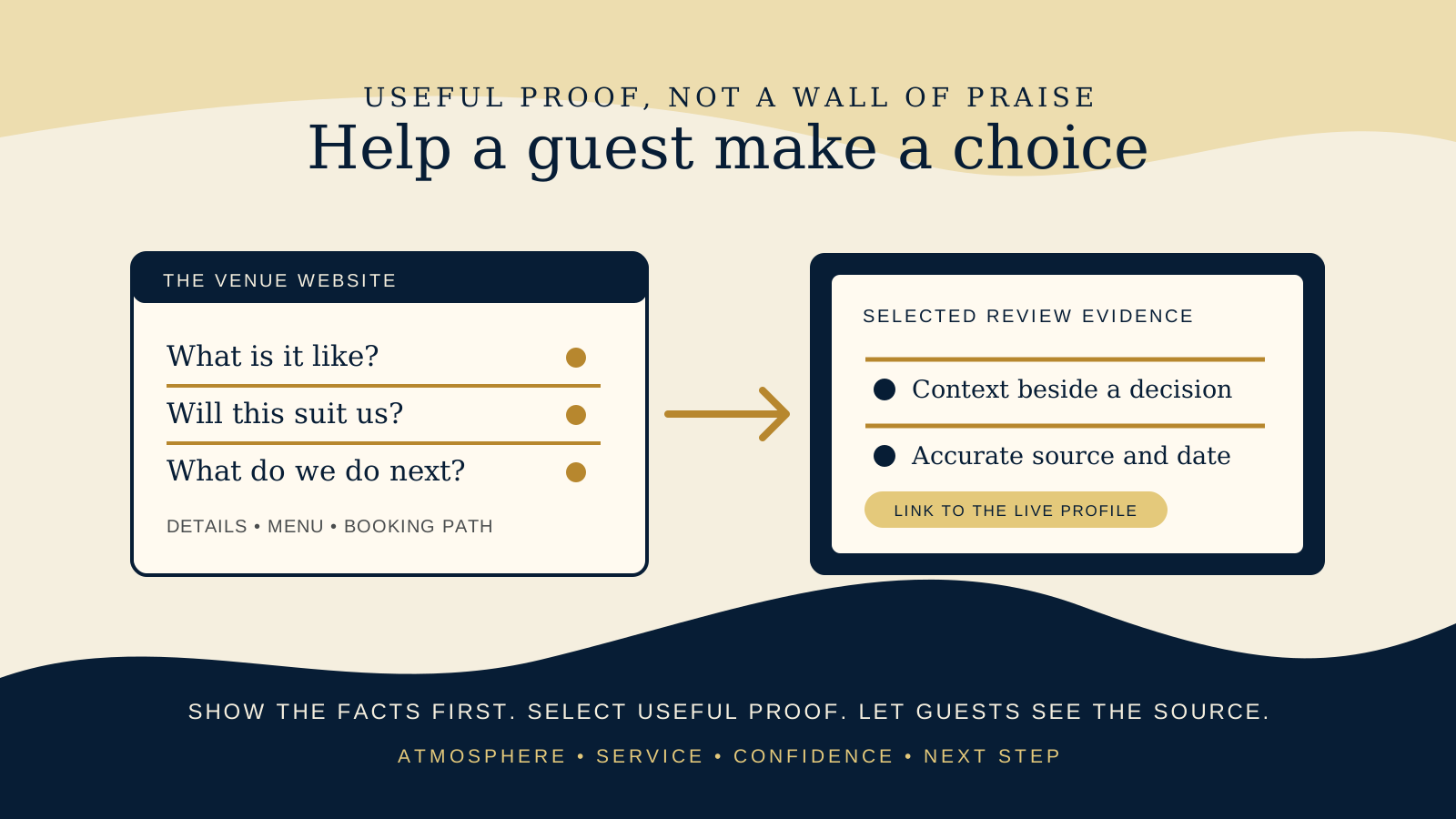
A website is not a display cabinet for every compliment a venue has received. Its first job is to help a guest understand the experience and take the next step. That means clear menu or room information, current hours, location, accessibility or arrival details where useful, and an obvious booking, ordering, calling, or enquiry path.
Selected reviews can make that information more believable. A short excerpt about a calm service style, thoughtful dietary care, a private dining experience, or a comfortable stay can support a relevant claim when it sits beside the decision it helps answer. It should not become the only evidence a guest gets.
Google says a business can share a direct review link with customers, and that replies to reviews are public after review. Treat the source profile as the live record. A guest should always be able to reach it, see the wider context, and decide for themselves.
Start with the guest questions your website must answer without a review
Before choosing an excerpt, list the questions a first time guest is actually trying to settle. For a restaurant or cafe, that may be whether the place feels right for a quiet lunch, whether dietary needs can be discussed, how the service works, or whether a group can book comfortably. For a boutique stay, it may be arrival, room character, location, or the feel of the host experience.
Answer those questions in the venue's own words and with useful facts first. A menu page should show the current menu. A private dining page should explain capacity, enquiry route, and the kind of gathering it suits. A stay page should show the real room and arrival information. A review can then support that page's point, instead of doing the work of missing content.
This keeps the page useful for guests who do not read testimonials and makes the review choice more disciplined. The question is not, “What is our most flattering review?” It is, “What proof would help someone decide whether this specific experience fits?”
Show proof that is specific, current enough, and connected to the page
Choose a small set of excerpts that relate to a real decision. Good candidates tend to be precise rather than grand. They might help a guest understand atmosphere, a well explained dietary experience, the way a host handled a group, or the comfort of a stay. Keep the full meaning intact. Do not combine sentences from different reviews or trim one until it says something the reviewer did not mean.
For every excerpt, show a short accurate quotation, the reviewer display name exactly as it appears publicly, the review date, a clear Google source label, and a direct link to the original review. Do not present an excerpt as an anonymous house testimonial or make it look as though it was written for the venue's website.
Set a review date standard that suits the service. A comment about a renovation, a seasonal menu, an old booking process, or a former room type can become misleading even if it was accurate at the time. Refresh or remove stale excerpts, especially when the surrounding page changes. Guests and reviewers can update reviews, so revisit the live source before each planned website refresh.
Choose one of three safe ways to display reviews
A small curated set with source links works well on a home page or a dedicated trust section. Keep it short, generally two to four selected excerpts. Give each one the reviewer display name, date, Google label, and original source link. This is useful when the set represents different parts of the guest experience without crowding out the main content.
Contextual quotes near a relevant decision are often more useful than a broad testimonials section. A brief, accurately attributed excerpt can sit near a private dining enquiry form, a dietary information section, or a boutique stay detail. The page should still state the real policy, facilities, or process. The excerpt is supporting evidence, not a replacement for an answer.
A clear link to the full live review profile is the lightest option. It works when the venue has many reviews, the page is already content rich, or the team cannot yet keep selected excerpts current. Use plain link language such as “Read current Google reviews” and let the live profile carry the wider conversation.
These patterns can be combined carefully. For example, a small selected set on the home page and a profile link in the footer may be enough. Do not repeat the same praise across every page until it feels like a substitute for useful venue detail.
Attribute each excerpt carefully and keep the original meaning visible
Use the reviewer display name only as it is publicly shown, rather than adding a surname, job title, or location from elsewhere. Preserve the meaning of the excerpt. If a review has a useful detail and a reservation, do not remove the reservation in a way that changes the overall point.
Include the date shown for the review and a source label that makes the origin unmistakable. Link directly to the original review, not only to a general profile page, when that direct destination is available. The link lets a guest see the complete comment and current context. It also gives the venue a clear route to check whether the displayed excerpt remains accurate.
Do not state that copying a review is permitted. If there is any uncertainty about how an excerpt may be used, seek appropriate permission or advice before publishing it. The practical minimum is honesty: no invented reviews, no edited meaning, no anonymous relabelling, and no claim that a public review is an endorsement arranged for the site.
Do not use a heavy review widget when it distracts from the guest journey
A live widget can look convenient because it promises to keep itself current. It can also make a page slower, push the menu or booking route below the fold, show reviews that are no longer relevant to the page, or create a visual block that feels disconnected from the venue's own information.
Use a lighter approach when the page is primarily about a guest action, when mobile speed matters, when the website has a quiet visual style, or when the team needs to choose evidence for a particular decision. A small curated set or a simple profile link often gives guests the proof they need without asking an outside panel to take over the page.
If a widget is considered, test it on a phone with the real booking, menu, directions, and enquiry paths. Check what it loads, whether it is accessible, whether it shows the right venue, and whether it makes the next step harder to find. The useful standard is not whether the widget exists. It is whether it helps a guest decide and act.
Keep the Google Business Profile useful in its own right
The website and Business Profile should reinforce one another, not compete to be a second version of the same content. Google says complete and accurate Business Profile information helps it match a business with relevant local searches. It also says helpful replies to reviews can help a business stand out. That is a reason to maintain the profile and reply thoughtfully, not a promise of a particular local ranking.
Check the profile details against the site whenever hours, phone, address, booking route, or key venue information changes. Google says local results are mainly based on relevance, distance, and prominence. A review section on your own website does not override those factors, and it cannot promise a ranking result.
For the broader local search routine, read the restaurant SEO guide. The practical order remains the same: maintain accurate guest information, make the website easy to use, and let selected reviews support genuine decisions.
Website review markup can describe content, but it does not create an entitlement to Google stars
Do not add review markup to a venue's own LocalBusiness page expecting Google review stars. Google's review snippet guidance says self serving reviews for a LocalBusiness or Organization are not eligible for that feature, whether the markup is added directly or through a third party widget.
Structured data can still describe truthful content that is visible on a page, but it is not a promise that Google will show a search feature. Keep the visible review information accurate first, then make any technical decision around what the page can honestly support. The restaurant structured data guide explains the wider rule of marking up maintained facts, not hoped for search appearances.
Use a small monthly review routine so the proof stays useful
- Read the page as a new guest: confirm the venue, offer, practical details, and next step are clear without any review.
- Match each excerpt to a decision: keep only the reviews that support atmosphere, dietary confidence, service style, private dining, or stay quality in a specific, honest way.
- Check the live original: open the source review, confirm the display name, date, wording, and destination link, then remove or revise anything that has become stale.
- Check the Business Profile facts: compare hours, phone, address, and booking or website destination with the live site after a material change.
- Test the page on a phone: make sure selected proof has not pushed the menu, booking, calling, directions, or enquiry action out of sight.
- Leave review stars out of the plan: do not treat self serving review markup as a route to stars in Google results.
Use the free Restaurant Website Quick Score before deciding where reviews belong. It checks the guest facing essentials that should be clear before social proof is added, including mobile clarity, menu access, location detail, and the next step.
Want a practical review of the website's trust signals?
The US$35 Website Check reviews the live mobile journey, menu or stay information, booking or enquiry path, essential venue details, visual clarity, and search basics. You receive a focused priority list for making the useful proof easier to find without burying the guest's next step.
Get the US$35 Website CheckSources
- Google Business Profile Help, read and reply to reviews
- Google Business Profile Help, tips to improve local ranking on Google
- Google Search Central, review snippet structured data